
Commercial Roofing in Greenville, TX
Greenville's shops, storefronts, and warehouses wear flat roofs, not shingles. A roofer paces the membrane, grades each seam and drain, and puts it on record before naming a commercial roofing figure.
- A roofer beside you through the claim
- No hard close after the estimate
- Written terms on the work itself
Greenville's commercial roofing, from Main Street to the highway
Greenville, TX carries a modest but real base of commercial roofing. The old core downtown keeps its preserved masonry storefronts, Wesley Street runs the retail strips, and warehouse and light-industrial buildings spread out toward the highway and the county line. Every one of those roofs is flat or low-slope: a single-ply sheet, built-up asphalt, or a coat.
A roofer sizes up the deck, the drains, the seams, and any soaked insulation, and puts the true condition on record with dated photos before naming a price. The read opens with a no-cost inspection.
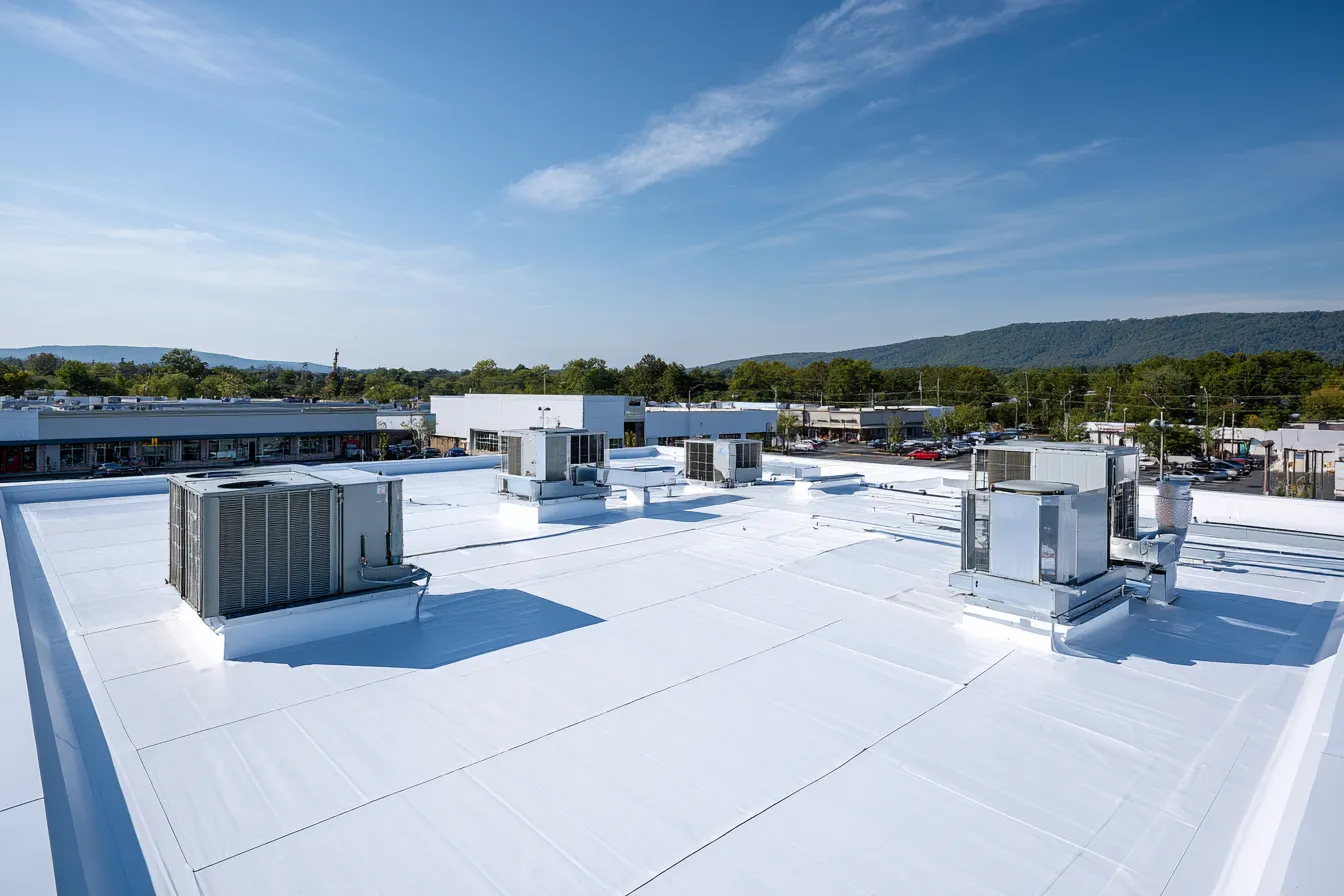
Flat-roof systems that fit a Greenville building
No one flat system wins outright; the building settles which one fits. Drainage, how often a worker is up servicing rooftop units, whether a kitchen exhausts across the roof, and how long you intend to hold the property all push the decision, and on a value-market budget the real question is fit, not sticker price. A roofer commits to a system only once the roof has been read and put on record. Below are the low-slope roofs put down and maintained on Greenville buildings, from a Main Street storefront to a warehouse on the county's edge.
TPO
A light-colored single-ply sheet, heat-welded at the seams, that ends up over most small retail boxes. The bright face bounces the Texas sun off instead of drinking it in, trimming the cooling bill and fitting a Wesley Street strip working to a budget.
EPDM
A black rubber sheet chosen for stamina, not looks. Largely left alone, it holds up for decades over a broad, uncluttered deck, which is what makes it right for a Hunt County warehouse or an open industrial bay with few rooftop units in the way.
PVC
A welded membrane made for roofs a kitchen punishes. The grease and fryer exhaust that chew through ordinary sheets simply shed off it, so it fits here over a downtown cafe or anywhere a hood vents upward.
Modified bitumen
Asphalt toughened with reinforcement and torched or rolled down in courses, patient with foot traffic and a corner that drains slow. You find it most on the smaller decks a worker is up on often to tend equipment.
Built-up roof (BUR)
The veteran tar-and-gravel build, layer laid over layer until the roof is thick and slow to quit. A few of Greenville's oldest downtown roofs still wear it, where decades of proven wear beat the added labor.
Roof coatings
A silicone or acrylic coat spread over a roof worn on the surface yet sound below, winning back reflective years at a slice of a tear-off's price. The coat holds only where the deck reads dry; sprayed over damp insulation, it traps the moisture instead.
Unsure what is even up on the roof, or how many years a rough Hunt County hail day has quietly cost it? That answer comes from a read. A roofer names the membrane, gauges the life left in it, and dates a photo of any storm bruising, so the repair-or-replace decision leans on evidence and not a hunch. For where each route lands on a Greenville budget, the roofing cost guide breaks the ranges out by system.
Repair, coat, or re-roof, read plainly
Nearly every commercial job in Greenville lands on one of four routes, and the space between them is real money on a value-market budget. A roofer names which route your building is on, in writing, before a crew is ever put on the calendar.
- 01Repair only the part that gave out
- The lowest-cost path with integrity when the rest of the roof still has road left in it: a seam lifting at the edge re-welded, a plugged drain opened and reflashed, a brittle stretch of wall flashing swapped, or a rooftop-unit collar sealed fresh. Every fix ties back to the membrane already down and carries its own price.
- 02Coat a roof that is still sound
- A roof worn on top but solid in structure can carry a silicone or acrylic coat that resurfaces it and returns reflective years at a slice of a tear-off's cost. Moisture is the trap: a roofer reads the insulation first, since a coat laid over trapped water buries the fault rather than mending it.
- 03Re-roof once the system is spent
- When a membrane is beyond both coating and patching, a fresh low-slope build goes down, single-ply, modified bitumen, or built-up, fastened against the straight-line wind that sweeps open Hunt County ground. A property owner takes this route only when the math shows leak-chasing outruns a clean start.
- 04Put the coat-versus-replace call on paper
- Choosing between renewing and replacing turns on four readings: how much foot traffic the roof sees, moisture held in the insulation, the shape of the deck, and how long you mean to keep the building. A roofer gathers all four and writes the call down before anything is sold, never after the fact.
A flat roof takes hail every bit as hard as a pitched one; it just conceals the bruising, and a popped seam or a dented sheet gives away nothing from the parking lot. On the first visit a roofer records and dates whatever a Hunt County storm left behind, then tells you outright whether opening a claim is even warranted. The storm damage page covers what a flat roof reveals after a hit.
What a Greenville building owner asks first
Plain answers on choosing a system, hail you cannot spot from the lot, keeping tenants dry, and where a commercial roof warranty really lives.
Q1On a lean budget, is coating smarter than replacing?
Q2The building isn't old, yet a tenant keeps flagging drips. What's going?
Q3If hail wrecks the membrane, who records it, and who handles the claim?
Q4How long should a new flat roof last on a Greenville building?
Q5Who stands behind a commercial roof, the maker or the roofer?
Q6Do downtown's old buildings need a different roof than the highway warehouses?
Scope the roof and get it on file.
A roofer walks the flat roof, logs the membrane and flashing condition, and puts a straight scope and cost range in writing for the facility. The visit is free, held or acted on at your call.